
How to Find Your Hidden Champions: A DIY Playbook

A practical guide to identifying customer advocates from your sales and CS calls. Find champions hiding in your call recordings without begging CS for nominations.
Your reference pool is empty. Again. Meanwhile, customers are saying incredible things on calls every day—but none of it gets captured. This playbook changes that.
The Problem Everyone Has
Sales needs a healthcare customer who can speak to compliance. Customer marketing has been asking CS for nominations for weeks. The incentive program you set up yielded three names—two of whom are "too busy" and one who left the company.
Meanwhile, your customers are saying incredible things on calls every single day. They're sharing outcomes, praising your team, comparing you favorably to competitors. But none of it gets captured. None of it becomes usable.
The champions exist. They're just invisible.
This playbook changes that. You're going to analyze your own call recordings to surface the advocates you didn't know you had—without begging CS, without awkward surveys, without waiting for someone to remember who's happy.
It takes an afternoon. You'll walk away with a ranked list of champions, complete with quotes, outcomes, and specific recommendations for how to engage each one.
Let's get into it.
What You'll Need
Before you start, make sure you have:
- Access to call recordings — Gong, Fathom, Fireflies, Chorus, or whatever your team uses
- Ability to download or copy transcripts — Every system handles this differently; you'll need to figure out your specific export process
- Participant data — Names, titles, and roles for people on the calls (sometimes embedded in transcripts, sometimes available separately)
- Claude or ChatGPT — Paid versions are recommended for access to more intelligent models and faster processing
- 2-3 hours — For your first account; it gets faster once you know the workflow
That's it. No special tools, no budget approval, no waiting on other teams.
Step 1: Select an Account to Analyze
Start with one account. Not ten. Not your whole customer base. One.
Pick an account where you have access to both sales calls (demos, negotiations, onboarding) and customer success calls (check-ins, QBRs, support). This gives you visibility into the full customer journey—you'll often find champions from the sales process who dropped off CS's radar entirely.
Ideally, choose an account you believe is happy: a recent renewal, an expansion, low support ticket volume. You're learning the process, so start where you're likely to find positive signals.
You can run this on every account eventually. But start with one to see how it works.
Step 2: Export All Transcripts
Go into your call recording system and download every transcript for that account. Sales calls, CS calls, QBRs, support escalations—get everything. Don't filter yet.
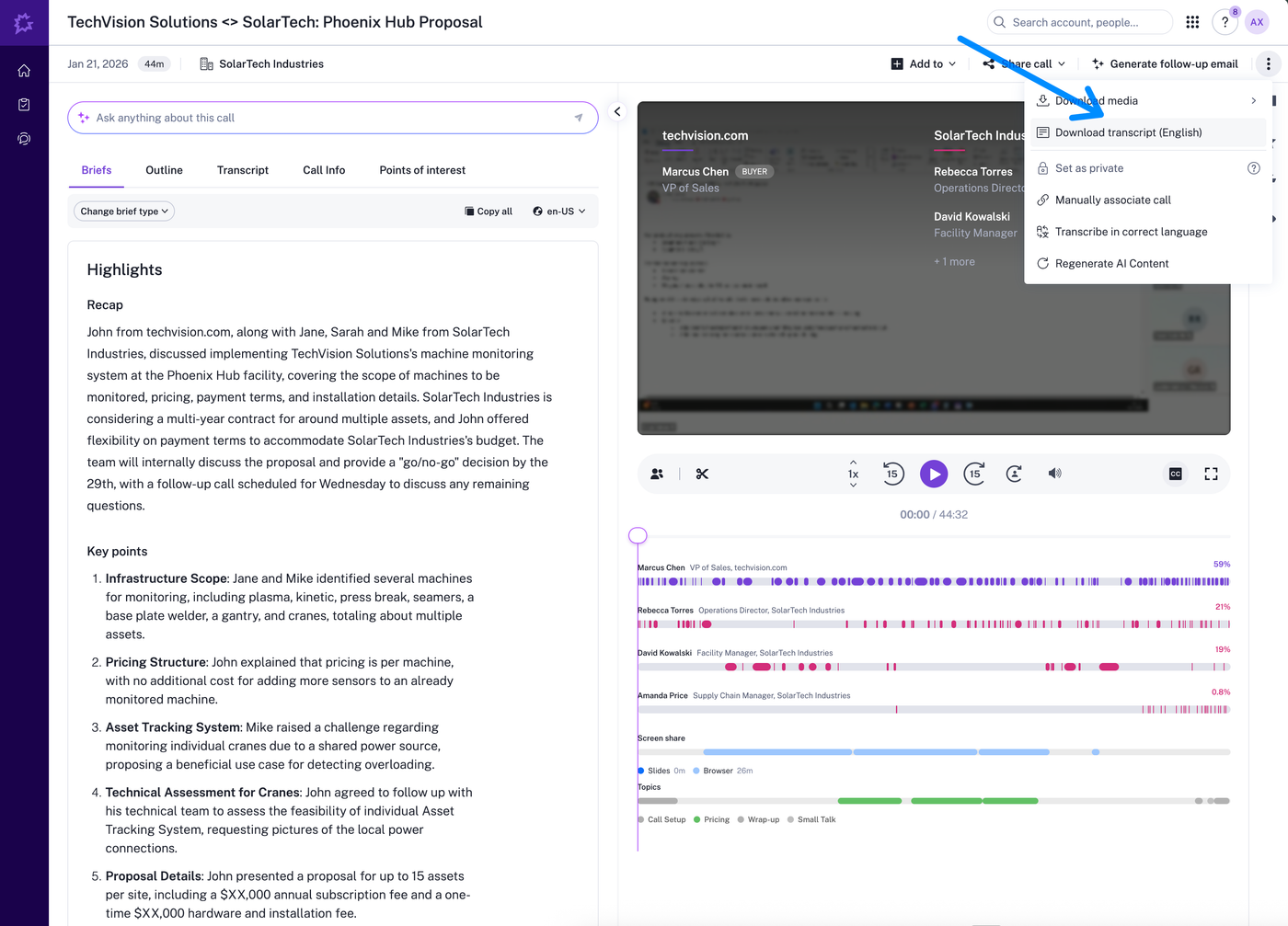
Add Participant Data
This step is critical. The AI needs to know who is speaking to identify potential champions.
Some call recording systems include participant names and titles directly in the transcript. If yours does, you're set.
If it doesn't, you'll need to find the participant information in your call recording system (usually in the call details) and add it to the top of each transcript file.
Organize Your Files
Name your files clearly so you can track what you've analyzed. Keep them all in a single folder for the account.
Step 3: Run Single-Call Analysis
Here's the challenge: ChatGPT and Claude have file limits. You can't upload 50 transcripts at once and ask for analysis.
The solution: analyze transcripts in batches, then consolidate the results.
The Process
- Open ChatGPT or Claude
- Copy Prompt #1 from the appendix below
- Upload 5-10 transcripts at a time (ChatGPT typically allows up to 10 files per conversation)
- Run the prompt and save the output for each call
- Repeat with the next batch until you've analyzed all transcripts
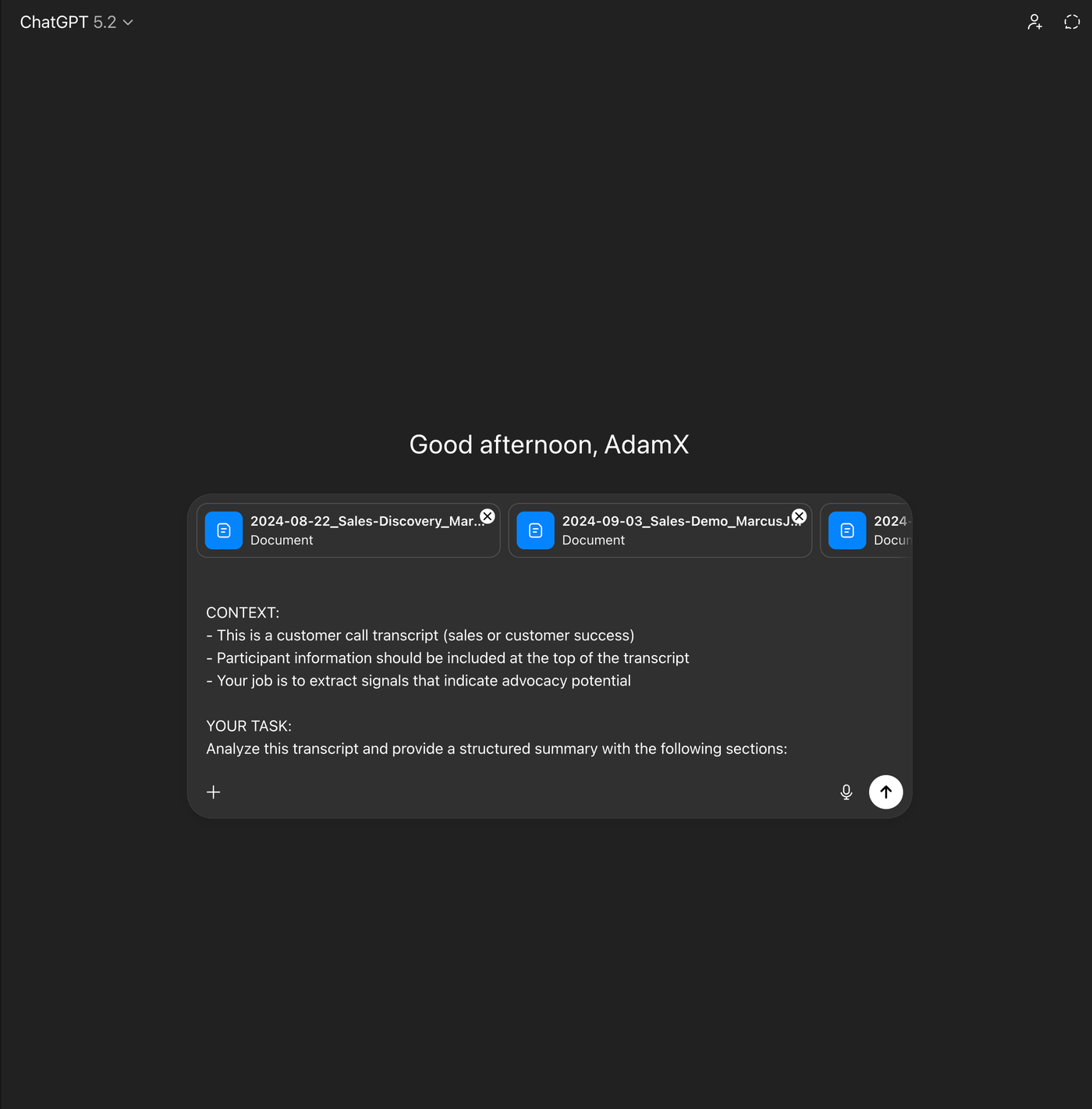
Each batch takes about 2-3 minutes to process. For 30 transcripts in batches of 10, you're looking at about 10-15 minutes of actual work—though you can do other things while waiting.
What You'll Get
For each call, the prompt extracts:
- Overall sentiment of the conversation
- Potential champions identified (by name and title)
- Key quotes demonstrating satisfaction or advocacy
- Specific outcomes and metrics mentioned
- Pain points the product solved
- Competitive context (mentions of alternatives)
- Any concerns or friction raised
- Signals of advocacy readiness
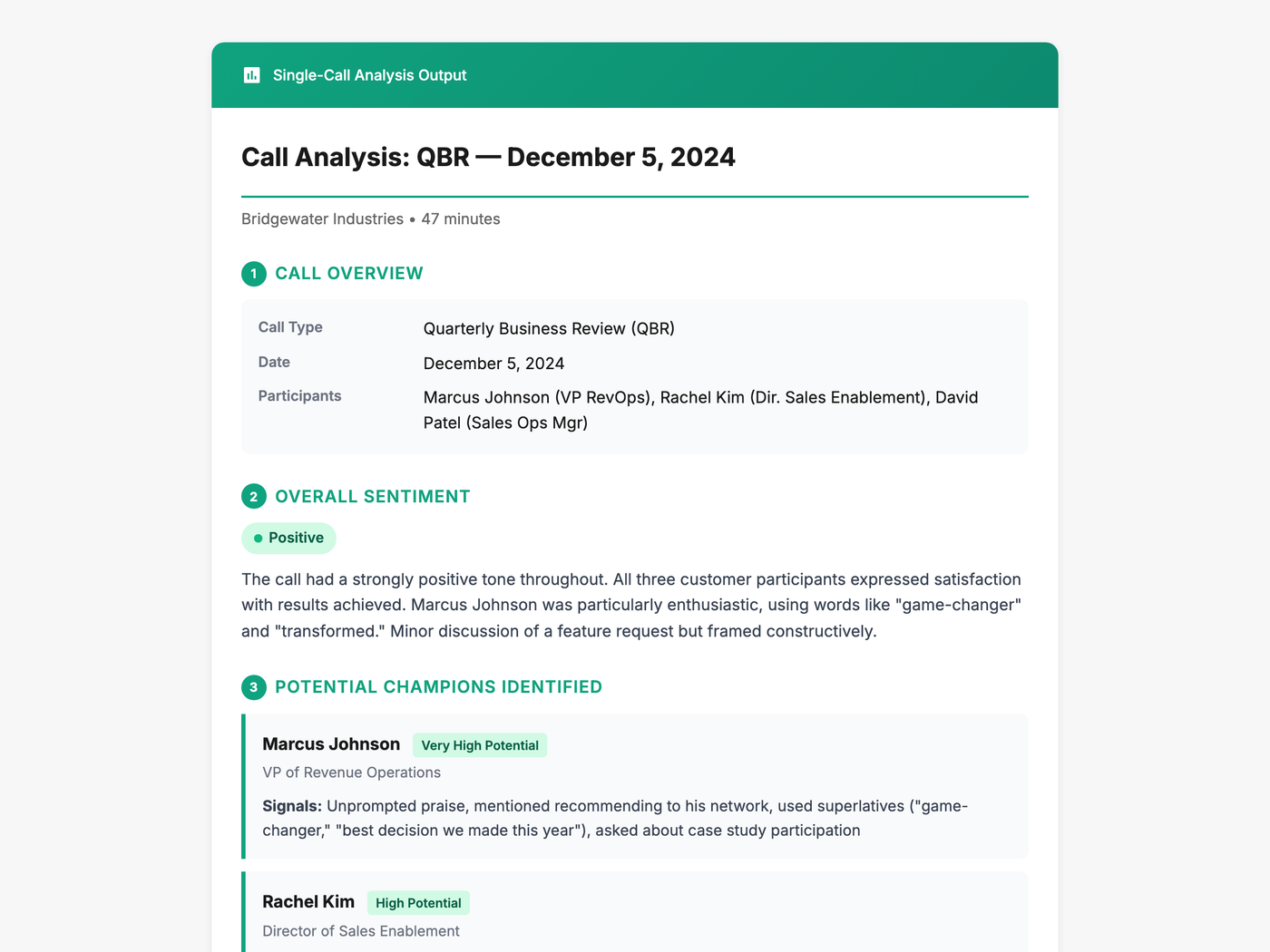
Save each output to a text file. You'll need all of them for the next step.
Step 4: Consolidate and Identify Champions
Now for the payoff.
You have 30 (or however many) individual call summaries. Each one captures signals from a single conversation. Now you're going to synthesize all of them to identify patterns and rank your champions.
The Process
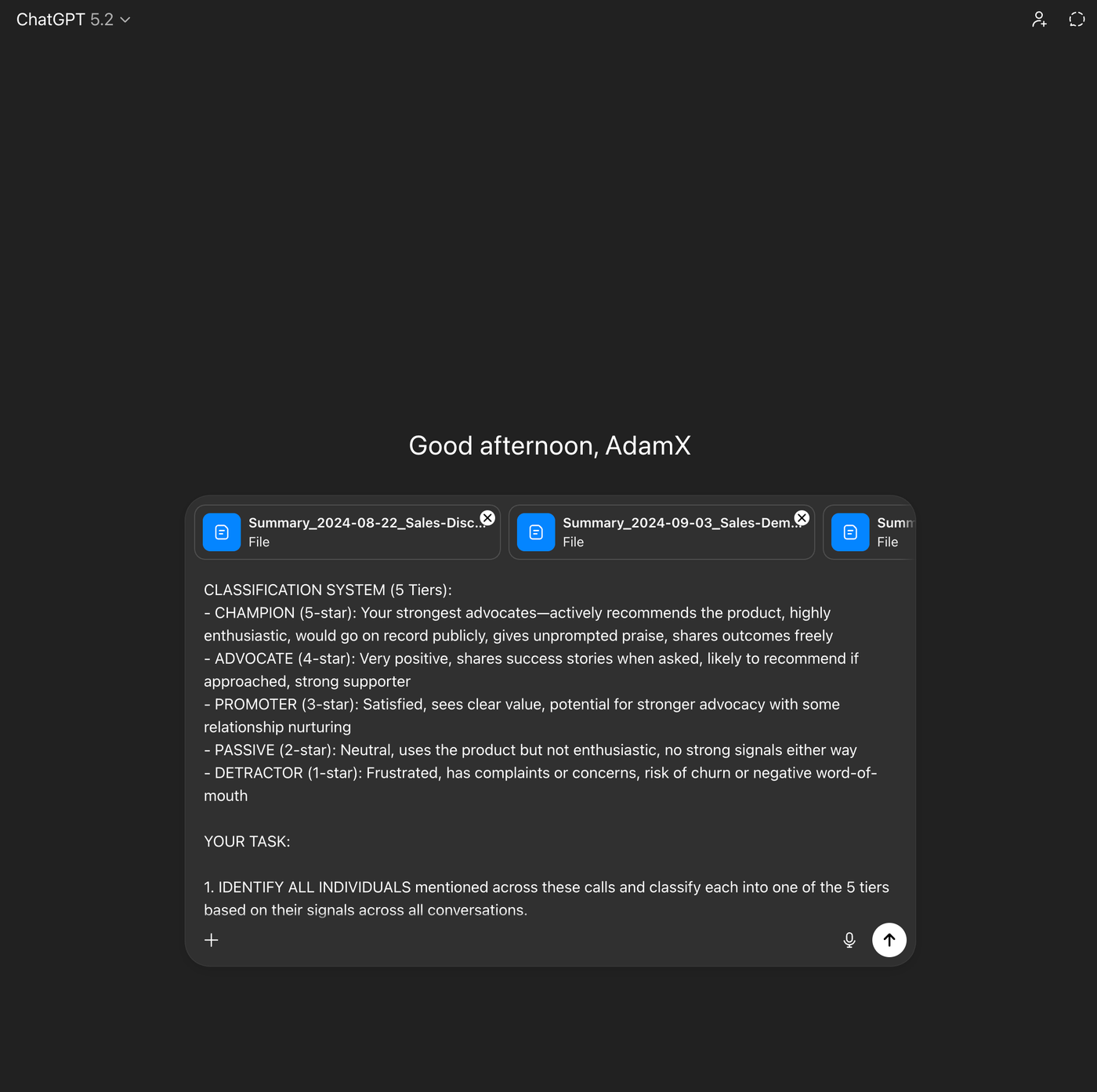
- Open a new ChatGPT or Claude conversation
- Combine your call summaries into fewer documents (ChatGPT has document limits, so consolidating 30 summaries into 3-5 files makes upload easier)
- Upload the consolidated summary files
- Add Prompt #2 from the appendix
- Run it
The 5-Tier Classification
The consolidation prompt classifies each person into one of five tiers:
- Champion (5-star) — Your strongest advocates—actively recommends, highly enthusiastic, would go on record publicly
- Advocate (4-star) — Very positive, shares success stories, likely to recommend if asked
- Promoter (3-star) — Satisfied, sees clear value, potential for stronger advocacy with nurturing
- Passive (2-star) — Neutral, uses product but not enthusiastic
- Detractor (1-star) — Frustrated, complaints, churn risk
The Final Output
You'll get a document with two sections: a summary table with everyone identified sorted by tier, and detailed profiles for each person including tier classification, key quotes, what they value, outcomes mentioned, and recommended advocacy asks.
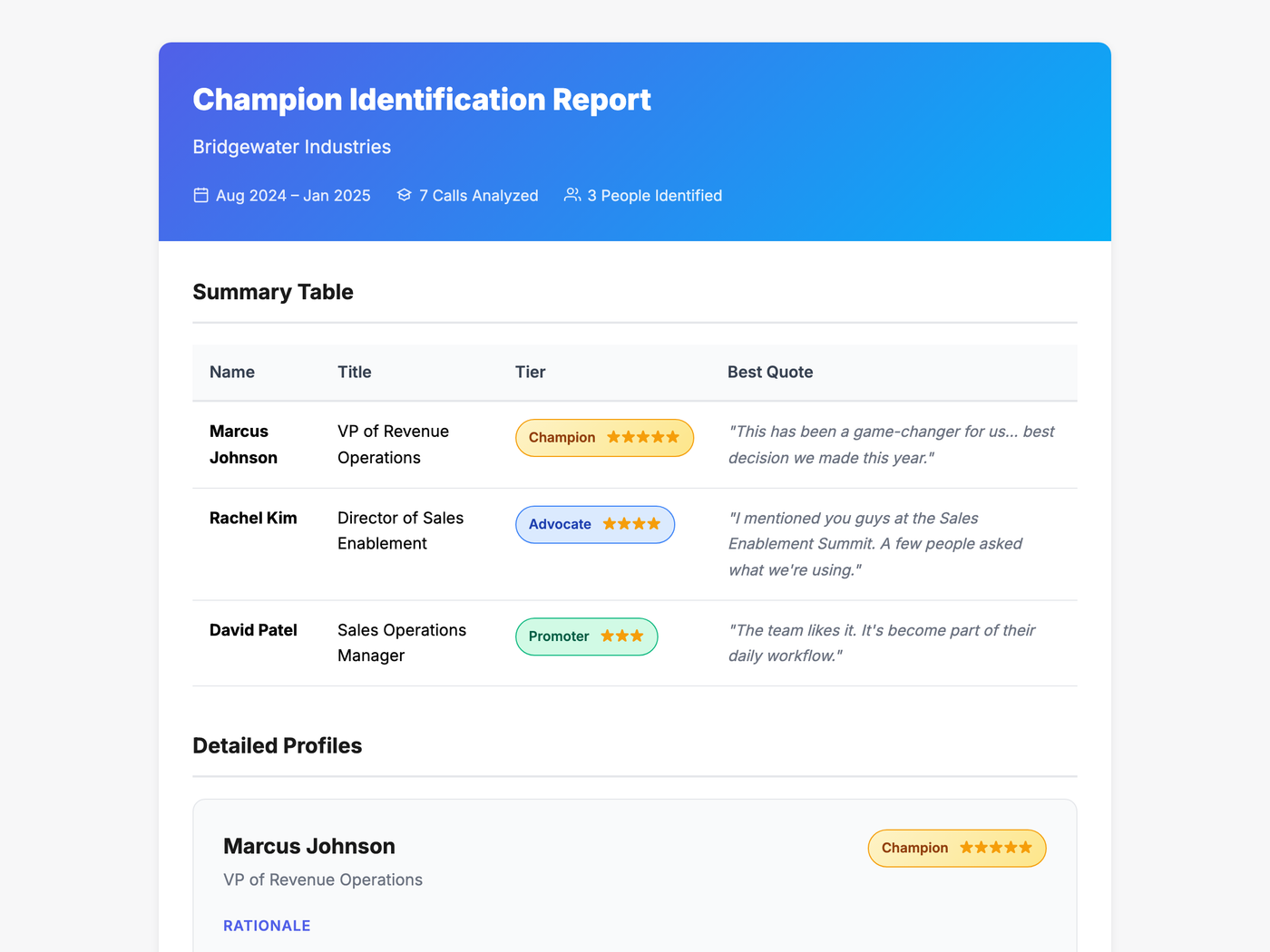
Copy this output into a Word document, and you have your champion report.
What You'll Discover
When teams run this playbook for the first time, they're usually surprised by what they find:
Champions You Didn't Know Existed
People who said incredible things on calls—but were never flagged by anyone. Sales-stage champions who got handed off to CS and forgotten. Individual contributors who are bigger fans than the executives everyone focuses on.
More Potential References Than Expected
Most accounts have 2-3+ potential advocates, not just one. The "empty reference pool" was never actually empty—it was just invisible. You didn't have a way to see who was saying what.
Nuanced Signals
Some accounts everyone assumed were happy turn out to have lukewarm sentiment when you read the transcripts. Other accounts you weren't sure about have hidden champions. Individual people matter more than account-level assumptions.
Ammunition You Already Have
Quotes you can use immediately (with permission). Specific outcomes and metrics mentioned organically—not extracted through awkward survey questions. Competitive win language in the customer's own words.
The insight: The champions were always there. You just didn't have a way to see them.
What's Next: From Playbook to Engine
You've now done this for one account. You have a champion report with real names, real quotes, and specific recommendations.
What if you want to go further?
Scale to All Accounts
The same process works for every account. But the manual effort multiplies: 100 accounts × 30 calls each = 3,000 transcripts to process. That's weeks of work, not an afternoon. It's possible. It's just time-intensive.
Make It Continuous
New calls happen every day. Champions emerge. Sentiment changes. A champion today might be frustrated next quarter.
Running this playbook quarterly is a project. Running it weekly is a full-time job. Running it continuously—catching champion signals as they happen—requires infrastructure.
Generate Artifacts from Your Champions
Once you've identified champions, you can use similar prompt-based approaches to draft case studies from their calls, extract material for G2 and Gartner reviews, create testimonial content, and build reference briefing documents.
Each artifact type needs its own prompt and process. The champion identification is just the first step.
Turn This Into an Engine
This playbook is a powerful one-time exercise. It works. You'll find champions you didn't know you had.
But if you want this running continuously—across all your accounts, updated with every new call, generating artifacts automatically—that requires turning the playbook into an engine.
The key differences between a playbook and an engine:
- Continuous vs. one-time: An engine analyzes every new call as it happens, not just when you remember to run the process
- Sentiment tracking: Champions can become detractors over time; an engine catches changes before it's too late
- Artifact generation: Beyond identification, an engine can generate case studies, testimonials, G2 review drafts, and reference briefings automatically
- Scale: Running this manually across 100+ accounts is a full-time job; an engine handles it without additional headcount
Ready to Start?
You have everything you need:
- The process (4 steps)
- The prompts (copy-paste ready below)
- The expected outputs (summary table + detailed profiles)
Pick an account, export the transcripts, and find your hidden champions.
Appendix: The Prompts
Copy and paste these prompts directly into ChatGPT or Claude.
Prompt #1: Single-Call Analysis
Use this prompt for each individual transcript (or batch of transcripts).
You are analyzing a customer call transcript to identify potential customer champions, advocacy signals, and key context.

CONTEXT:
- This is a customer call transcript (sales or customer success)
- Participant information should be included at the top of the transcript
- Your job is to extract signals that indicate advocacy potential

YOUR TASK:
Analyze this transcript and provide a structured summary with the following sections:

1. CALL OVERVIEW
   - Call type (sales demo, CS check-in, QBR, support, etc.)
   - Date (if discernible from the transcript)
   - Key participants and their roles

2. OVERALL SENTIMENT
   - Classification: Positive / Neutral / Negative
   - Brief explanation of why

3. POTENTIAL CHAMPIONS IDENTIFIED
   - Name and title of anyone showing advocacy signals
   - What signals they showed (enthusiasm, willingness to recommend, unsolicited praise, specific outcomes shared, etc.)

4. KEY QUOTES
   - Direct quotes that demonstrate satisfaction, outcomes, or advocacy potential
   - Include speaker name and context for each quote
   - These should be exact quotes from the transcript, not paraphrased

5. OUTCOMES/RESULTS MENTIONED
   - Any specific metrics, improvements, or results the customer mentioned
   - Include exact numbers if stated (e.g., "saved 20 hours per week", "reduced costs by 30%", "increased conversion by 15%")

6. PAIN POINTS SOLVED
   - What problems or challenges did the customer say the product addressed?
   - How did they describe their situation before vs. after?

7. COMPETITIVE CONTEXT
   - Any mentions of competitors or alternatives they considered
   - Why they chose this product over others
   - Comparisons made (favorable or unfavorable)

8. CONCERNS OR FRICTION
   - Any complaints, frustrations, or concerns raised
   - This is important context for assessing true advocacy potential

9. ADVOCACY READINESS SIGNALS
   - Any explicit mention of willingness to be a reference, do a case study, or write a review
   - Any unprompted recommendations to others
   - Statements like "I've already told my colleagues about this" or "I'd be happy to talk to other prospects"

Format your response as clean markdown that can be easily collected with other call summaries.
Prompt #2: Champion Consolidation
Use this prompt after you've collected all your single-call summaries. Upload the summary files first, then add this prompt.
You are analyzing summaries from multiple customer calls for a single account to identify and classify customer champions.

CONTEXT:
Above are summaries from multiple calls with the same customer account. Your job is to synthesize these into a comprehensive champion identification report.

CLASSIFICATION SYSTEM (5 Tiers):
- CHAMPION (5-star): Your strongest advocates—actively recommends the product, highly enthusiastic, would go on record publicly, gives unprompted praise, shares outcomes freely
- ADVOCATE (4-star): Very positive, shares success stories when asked, likely to recommend if approached, strong supporter
- PROMOTER (3-star): Satisfied, sees clear value, potential for stronger advocacy with some relationship nurturing
- PASSIVE (2-star): Neutral, uses the product but not enthusiastic, no strong signals either way
- DETRACTOR (1-star): Frustrated, has complaints or concerns, risk of churn or negative word-of-mouth

YOUR TASK:

1. IDENTIFY ALL INDIVIDUALS mentioned across these calls and classify each into one of the 5 tiers based on their signals across all conversations.

2. CREATE A SUMMARY TABLE at the top of your response:

| Name | Title | Tier | Best Quote (Preview) |
|------|-------|------|---------------------|

Sort by tier: Champions first, then Advocates, Promoters, Passives, Detractors.

3. CREATE A DETAILED PROFILE for each person (in the same order as the table):

## [Name], [Title]

**Tier:** [Classification]

**Rationale:** Why this classification? What signals across the calls support it?

**Key Quotes:**
- "[Quote 1]" — [Call date/type]
- "[Quote 2]" — [Call date/type]
- "[Quote 3]" — [Call date/type]

**What They Value:** Key themes about what they love (or dislike) about the product

**Outcomes Mentioned:** Specific results, metrics, or improvements they cited

**Suggested Ask:** What type of advocacy would be appropriate given their tier?
- Champions → Reference calls, case studies, video testimonials, G2 reviews
- Advocates → Written testimonials, quote approval, internal referrals
- Promoters → Nurture the relationship first, then lighter asks
- Passives → Not ready for asks—focus on improving their experience
- Detractors → Address their concerns before any advocacy discussion

**Caveats:** Any concerns, risks, or context to be aware of

---

4. ACCOUNT SUMMARY at the end:
- Total people identified by tier (e.g., "2 Champions, 3 Advocates, 1 Promoter, 2 Passives, 0 Detractors")
- Overall account health assessment
- Top recommendation for immediate action

Format as clean markdown that can be easily converted to a Word document.

Written by AdamX Team
Insights, tips, and updates from the AdamX team on customer proof, buyer journeys, and B2B marketing.


